
Gas turbines ¡ª whether in power generation, offshore platform duty, or industrial process driving ¡ª require a compact, reliable gearbox to drive their auxiliary systems from the main shaft at the correct speed. The accessory gearbox on a gas turbine distributes power from the high-speed turbine spool, typically 3 000 to 30 000 rpm depending on turbine size, to the fuel control unit, lubrication oil pump, hydraulic pump, starter motor, and electrical generators, each of which requires a specific speed. Planetary gearboxes within the accessory gearbox achieve the required speed ratios in the most compact, lightest format available ¡ª critical constraints in aero-derived industrial turbines where weight and envelope are primary design drivers inherited from the aircraft application.
Gas Turbine Auxiliary Drive Requirements
Each auxiliary system on a gas turbine has a specific speed requirement that must be met precisely: the fuel control unit requires a constant speed proportional to engine speed for flow metering; the oil pump requires minimum pressure at idle and rated flow at full power; the starter motor requires a speed range to accelerate the turbine to self-sustaining speed. These different requirements are served by different gear ratios from the accessory gearbox, all driven simultaneously from the same turbine spool shaft. The accessory gearbox planetary stages are compact, lightweight, and designed to the same reliability standards as the turbine itself ¡ª since an accessory gearbox failure means a turbine shutdown.
| Auxiliary System | Required Speed | Turbine Speed | Required Ratio | Notes |
|---|---|---|---|---|
| Fuel control unit | 3 000 rpm | 15 000 rpm | 5:1 step-down | Speed-proportional metering |
| Lube oil pump | 3 000¨C6 000 rpm | 15 000 rpm | 2.5:1¨C5:1 | Pressure controlled by bypass |
| Hydraulic pump | 1 500¨C3 000 rpm | 15 000 rpm | 5:1¨C10:1 | Actuator control pressure |
| Permanent magnet generator | 12 000¨C24 000 rpm | 15 000 rpm | 0.8:1¨C1.6:1 | Brushless VF or constant frequency |
| Starter motor drive mode | 0¨C3 000 rpm | 0¨C3 000 rpm | Reversible planetary | Back-drives turbine from motor |
Ratios are illustrative for a medium industrial gas turbine at 15 000 rpm rated spool speed.
Weight and Compactness as Design Drivers
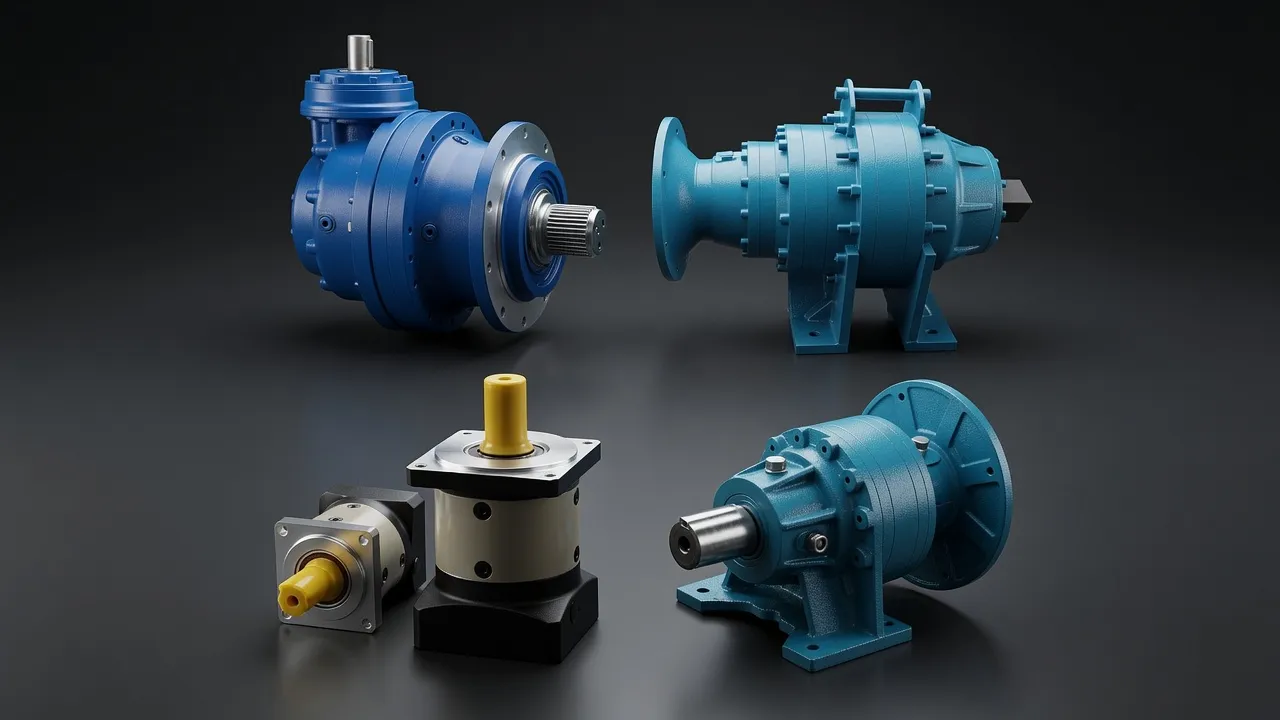
In aero-derived industrial gas turbines including the GE LM2500 and LM6000 series used extensively in Australian LNG facilities, offshore platforms, and power stations, the original aircraft design heritage means the accessory gearbox is engineered to the same weight density targets as aviation hardware. Every kilogram of accessory gearbox weight adds cost in the original engine unit and adds to the crane capacity required for installation or maintenance. Planetary gearing achieves the highest torque-to-weight ratio of any gear architecture, which is why it is the universal choice for high-performance accessory gearbox applications. The AB060 high-precision planetary series demonstrates the torque density achievable in a compact planetary format applicable to auxiliary drive applications in high-speed industrial turbine installations. The AF060 flange output planetary provides an alternative in a flange-mount configuration suited to accessory unit integration.
High Speed Gear Quality and Noise
Gas turbine accessory gearbox planetary gears operate at input speeds of 5 000 to 30 000 rpm ¡ª far above any standard industrial planetary gearbox application. At these speeds, the gear mesh frequency reaches 2 000 to 10 000 Hz, which falls in the audible frequency range and produces the characteristic high-pitched whine of gas turbine operation. Surface finish on gear tooth flanks must be below Ra 0.2 micrometres to minimise the micro-pitting and transmission error that generates this noise. Gear tooth profile corrections ¡ª tip relief, lead crowning, and profile crowning ¡ª are applied to each individual gear pair to minimise loaded transmission error at the specific operating speed and torque of each accessory gearbox stage.
Turbine Start Sequence and Reverse Drive
During turbine start, the starter motor drives the turbine spool through the accessory gearbox in reverse ¡ª the motor is the input and the turbine spool is the output, exactly reversing the normal power flow direction. The accessory gearbox planetary stages must transmit this reverse torque without damage while the turbine accelerates from rest to self-sustaining speed. For an LM2500-type turbine, self-sustaining speed is approximately 3 000 rpm; the starter motor drives the spool from 0 to 3 000 rpm in 30 to 60 seconds at a torque that may reach 2 to 3 times the rated continuous output torque. The planet gears and planet pin bearings must withstand this start cycle repeated thousands of times over the turbine service life. The EPT right-angle precision planetary series provides right-angle output configurations applicable to starter motor integration on small gas turbine auxiliary gearboxes, while the PGV planetary gearbox offers a reference for high-speed precision planetary drive performance in turbomachinery auxiliary applications.
Frequently Asked Questions
Speak with a Planetary Drive Specialist
Share your torque requirement, ratio, and application environment ¡ª our team at Condell Park NSW returns a sized recommendation and stock check within one business day. No obligation.