
Automatic gates on rural properties, feedlots, and grain handling facilities in NSW and Queensland face a combination of requirements that narrow the suitable gearbox field significantly. The drive must hold the gate stationary against wind loads and animal pressure without consuming power, operate reliably across wide temperature swings — from near-freezing winter nights to 45°C summer afternoons — survive dust, mud, and occasional pressure-washing, and do all of this for years without routine lubrication attention. The worm reducer’s inherent self-locking property addresses the first requirement directly; the right sealing and lubricant grade takes care of the rest.
Why Self-Locking Matters on Agricultural Gates
A standard electric actuator on a swing gate relies on a brake or a non-backdriveable screw jack to hold the gate in the open or closed position between actuations. A worm gearbox at a ratio of 1:30 or above is inherently self-locking — the lead angle of the worm thread is smaller than the friction angle of the bronze-on-steel contact, so a force applied to the output shaft (the gate arm) cannot reverse-drive the gearbox and motor. In practical terms, a 200 kg gate section swinging in a 60 km/h wind exerts a significant torque at the pivot — a correctly sized worm unit holds this load without requiring any motor current or brake engagement. The motor only draws power when the gate is actively moving.
Load Calculation for Swing and Slide Gates
Swing Gate Torque
The torque required to swing a gate equals the wind or animal pressure load multiplied by the moment arm from the pivot. For a 4-metre wide, 80 kg steel tube gate in a 60 km/h wind (dynamic pressure approximately 215 Pa), the wind force on the gate panel is roughly 215 × (4 × 1.2) = 1 032 N. The moment arm at the mid-panel point is 2 m from the pivot, giving a wind torque of approximately 2 064 N·m. The gearbox output acts at the end of the gate arm (typically 150–300 mm from the pivot), so the gearbox output torque needed is 2 064 ÷ 0.25 = 8 256 N·m in the extreme wind case — which represents a design maximum, not a normal operating condition. The drive gearbox output for normal gate opening (against gravity on a slightly tilted gate plus friction) is much lower: typically 300–800 N·m.
Slide Gate Torque
Slide gates on a rail system are driven by a rack-and-pinion from the gearbox output shaft. The drive torque equals the required rail force (sum of gate weight × rolling friction coefficient, typically 0.08–0.12 for clean steel rollers, plus wind force) multiplied by the pinion radius. For a 500 kg sliding gate at 0.1 rolling coefficient and 60 km/h wind load of 800 N, total rail force is (500 × 9.81 × 0.1) + 800 = 1 290 N. With a 50 mm pinion radius, output torque is 1 290 × 0.05 = 64.5 N·m — easily handled by a WPA 60 or 80 frame at 1:30.
| Gate Type | Gate Weight | Wind Design | Typical Output Torque | WP Unit |
|---|---|---|---|---|
| Swing gate, 3 m wide, farm | 60 kg | Light (rural) | 150–300 N·m | WPA 80, 1:30 |
| Swing gate, 4 m wide, feedlot | 90 kg | Medium (exposed) | 300–600 N·m | WPA 100, 1:40 |
| Slide gate, 5 m, rail | 300 kg | Medium | 60–120 N·m | WPA 60, 1:30 |
| Bi-fold gate, 6 m total | 120 kg | Medium | 200–400 N·m | WPA 80, 1:40 |
| Heavy stockyard gate, 5 m | 150 kg + animals | Heavy | 600–1 000 N·m | WPA 120, 1:40 |
Select one size above the calculated torque when the gate is in an exposed or high-traffic position.
IP Rating and Sealing for Outdoor Agricultural Use
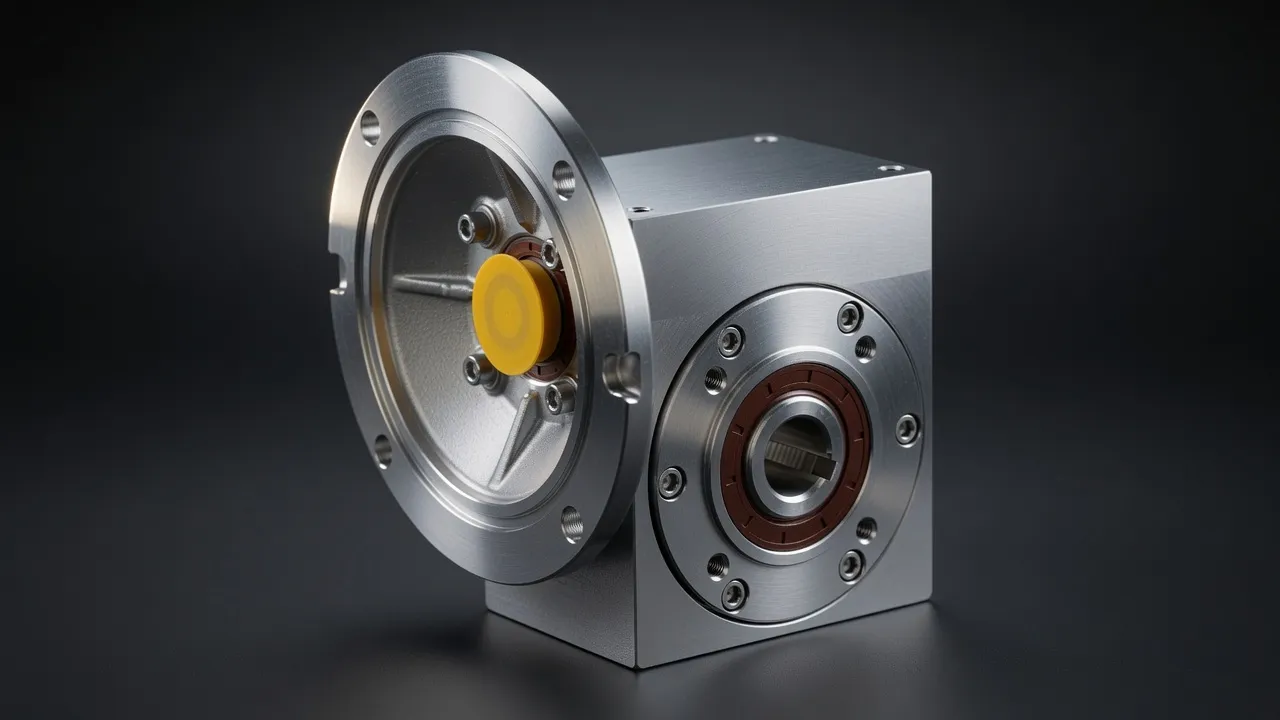
Agricultural gate actuator gearboxes live in conditions that destroy standard industrial units in two to three seasons. Mud, animal waste, and frequent high-pressure washing attack every seal gap. A minimum IP65 rating is the starting point — full dust exclusion and resistance to water jets from any direction. For feedlot installations where the gate actuator is directly in the animal traffic path and regularly coated in mud and manure, IP66 or IP67 is worth the upgrade. Specify reinforced lip seals on the output shaft with a labyrinth pre-seal stage, stainless steel fasteners throughout, and a sealed breather rather than a plain plug to prevent pressure-differential water ingress during temperature cycling.
Motor Selection and Control for Agricultural Gates
Most automatic farm gates use a 12V or 24V DC motor connected to a solar panel and battery system, making grid power unnecessary even in remote paddock locations. The worm gearbox output shaft connects to the gate arm via a simple rigid link or a ball-joint rod end. The motor control typically uses a simple timer relay or a limit switch pair — the gate opens when the switch fires, runs for a preset time or until the limit switch triggers, and then holds the position through the gearbox’s self-locking property. The DA series worm reducer is compact enough to mount directly on the standard gate post tube bracket used by most Australian automatic gate kit suppliers.
Lubrication for Infrequent-Use Applications
A gate that operates 20–50 times per day accumulates far fewer operating hours than an industrial gearbox, but it spends much more time idle — and idle time in a temperature-cycling environment is when condensation causes the most damage. A synthetic polyglycol oil at ISO VG 220 is the best choice for gate actuator gearboxes: it resists moisture emulsification far better than mineral oil, maintains adequate viscosity down to −15°C for cold NSW winter mornings, and provides a longer service interval without sludge formation. Change oil every two years regardless of cycle count, and inspect seals at the same time. The VRV030 precision worm gearbox is worth noting for high-cycle gate applications where positioning repeatability is required — automated livestock sorting gates in particular benefit from the low-backlash output.
Installation Tips for Reliable Long-Term Operation
Align the gate arm in the neutral position first
Set the gate to the mid-travel position and connect the gearbox output arm with the motor in its neutral (power-off) position. This ensures the motor does not start from a mechanically stressed condition.
Set limit switches with 5° travel margin
Position the limit switches 5° before the mechanical stop in both directions. This prevents the motor from stalling against the hard stop on every cycle — a common cause of premature worm wheel wear on gate actuators.
Apply anti-seize compound to the gate pivot
A seized pivot point transfers additional torque to the gearbox as the gate opens. Even a light smear of anti-seize or grease at the pivot pin reduces the gearbox load by 15–20% and extends pivot life simultaneously.
Check self-locking after one month of service
With the power disconnected, push the gate firmly by hand. If it moves at all from the parked position, the worm mesh may be worn or the ratio may be too low. Replace or respecify before relying on the gearbox to hold against animal pressure.
Inspect output shaft seal every 12 months
Remove the protective cover, clean the output shaft area, and confirm no oil trace around the seal lip. A weeping seal allows moisture to track along the shaft into the housing — early detection and seal replacement prevents a costly internal corrosion failure.
Frequently Asked Questions
Speak with a Drive Specialist
Send through your load data, speed requirement, and application environment — our team at Condell Park NSW provides a sized gearbox recommendation and stock availability check within one business day. No obligation.