
Belt conveyors shift everything from quarried aggregate to chilled ready-meals, yet the gearbox question is often treated as an afterthought until a burned-out unit halts a line on a Saturday night. This guide works through the numbers that matter when specifying a DA series worm gear reducer for a belt conveyor — torque, ratio, frame size, and the service factor that ties it all together.
How Belt Load Translates to Output Torque
The starting point is not motor power — it is the tangential force the drive pulley must apply to the belt. Multiply effective pull (in newtons) by pulley radius (in metres) and you have the raw torque demand at the gearbox output shaft. For a horizontal 650 mm wide belt running at 0.5 m/s carrying 120 kg/m of product, effective pull typically falls between 800 and 1 200 N. At a 150 mm radius drive pulley, that equals 120–180 N·m before any service or temperature correction.
Choosing the Right Speed Ratio
Ratio selection follows a straightforward chain: output rpm equals motor rpm divided by ratio, and belt speed equals output rpm multiplied by pulley circumference. A 4-pole 1440 r/min motor driving through a 1:30 reducer produces 48 r/min at the output shaft. With a 200 mm pulley (628 mm circumference), that gives a belt speed of roughly 30 m/min — well-suited to carton-handling, printing, and light-assembly lines.
| Ratio | Output RPM | Belt Speed (200 mm pulley) | Typical Application |
|---|---|---|---|
| 1:10 | 144 | 90 m/min | Sortation, high-speed packaging |
| 1:20 | 72 | 45 m/min | Carton sealing, filling lines |
| 1:30 | 48 | 30 m/min | General conveying, assembly |
| 1:40 | 36 | 23 m/min | Cooling conveyors, inspection |
| 1:50 | 29 | 18 m/min | Accumulation, oven exit |
| 1:60 | 24 | 15 m/min | Slow cooling, drying tunnels |
Input speed 1440 r/min; 200 mm drive pulley assumed.
Frame Size and Cantilever Load
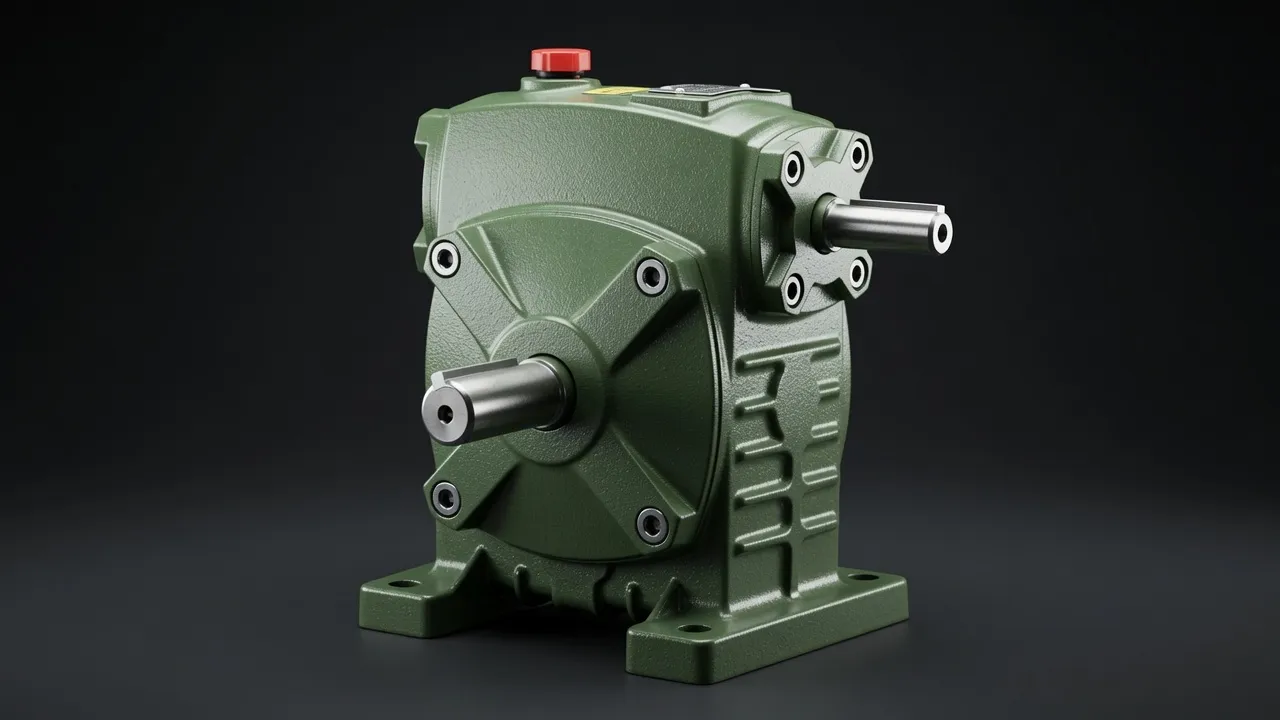
Centre-to-centre distance determines both torque capacity and the shaft diameter that carries the sprocket or coupling. At a 1:30 ratio a WPA 80 frame delivers 151 N·m output torque — fine for a 500 mm wide belt pulling 1 200 N. A WPA 100 at the same ratio yields 277 N·m, suited to 800 mm wide belts under moderate load. The cantilever load table in the WP catalogue sets hard limits on how much overhung sprocket weight the output shaft can take — exceeding those limits accelerates bearing failure faster than any torque overload.
Service Factor: Where Most Sizing Errors Happen
Catalogue torque ratings assume steady load, clean ambient air at roughly 20°C, and fewer than twelve start/stop cycles per hour. A recycling plant belt running 16 hours per day and subject to shock loads from irregular scrap pieces needs a service factor of 1.5, turning a 180 N·m theoretical requirement into a 270 N·m selection target. Inclined belts lifting bulk bags at 20° justify another 20–30% on top of that. Ambient temperatures above 40°C add a further 10% per 10°C above the baseline.
Foot-Mounted vs Hollow-Shaft Configuration
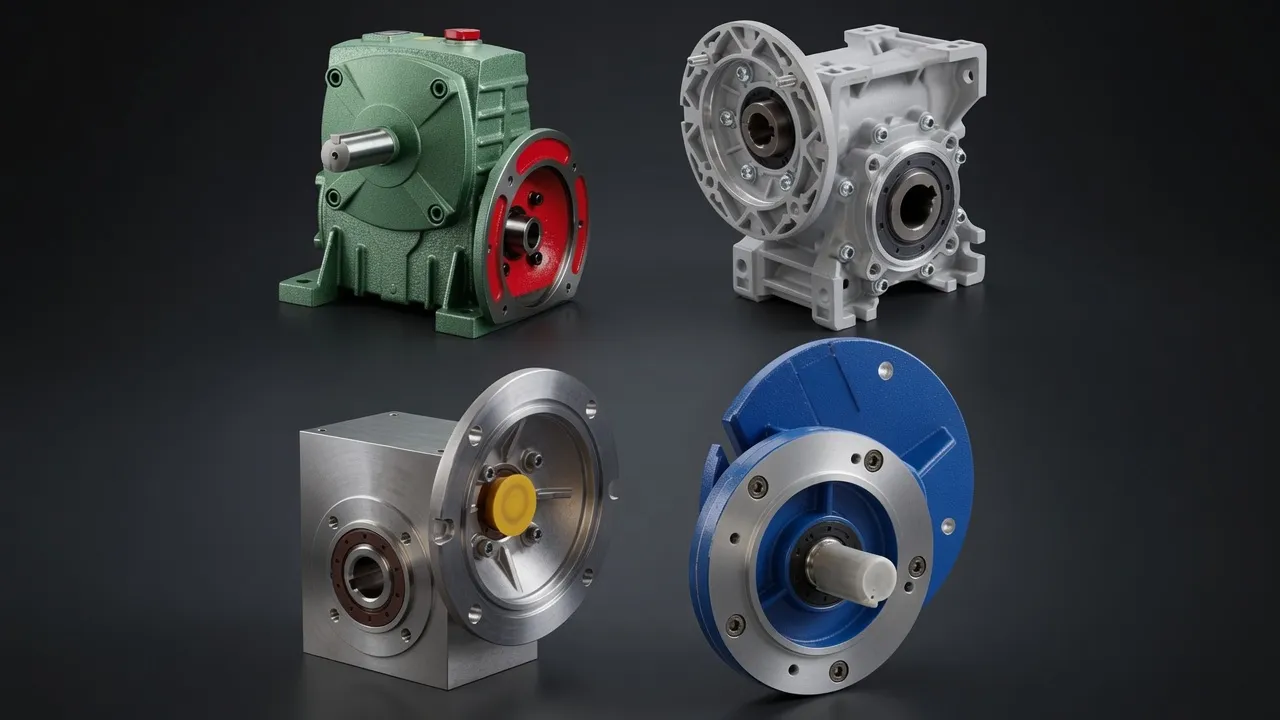
The classic WPA foot-mount with a chain or coupling to the head shaft suits conveyors where the motor and gearbox must be serviced independently. The KA series hollow shaft worm gearbox slides over the head shaft directly, eliminating the coupling, the second bearing housing, and the alignment procedure. Installation time drops from several hours to under an hour on a modular conveyor — a meaningful saving when the machine is one of thirty identical lines in a distribution centre.
Lubrication Grade for Continuous Conveyor Duty
Worm gearing runs on sliding contact that demands a heavier oil than rolling-element gears. ISO VG 220 is acceptable only for lightly loaded units at low ambient temperatures; VG 320 is the standard choice for most conveyor applications at 15–40°C. Above 40°C ambient — roof-mounted outdoor belts, bakery ovens, or foundry environments — switch to VG 460 mineral or a synthetic polyglycol. Change oil at 100 operating hours initially, then every 2 500 hours. For high-ambient applications, the NMRV aluminium-housed unit dissipates heat faster, while the WP iron housing provides superior rigidity under shock loads.
Frequently Asked Questions
Get a Sized Recommendation
Share your load data and target speed — our team at Condell Park NSW returns torque calculations and a stock check within one business day.