
The electronic continuously variable transmission (ECVT) in a power-split hybrid vehicle is one of the most ingenious applications of planetary gear mechanics in modern engineering. A single planetary gear set — ring gear, sun gear, planet carrier — simultaneously combines torque from an internal combustion engine and an electric motor, splits power between a generator and the drive wheels, and varies the effective drive ratio continuously without any clutches, gear shifts, or mechanical variable-ratio elements. Understanding how this works at a mechanical level reveals why the planetary gear set is the ideal mechanism for this application.
The Power Split Principle in a Toyota-Type ECVT
In a Toyota Hybrid System (THS), the engine connects to the planet carrier, the generator motor (MG1) connects to the sun gear, and the drive motor (MG2) and drive wheels connect to the ring gear through a fixed final drive ratio. Power splits between the three nodes according to the lever analogy of planetary gears: the carrier always rotates between the sun and ring speeds in a fixed ratio set by the tooth count. By varying the speed of MG1 (through electronic control of its current), the controller effectively changes the ratio between engine speed and drive shaft speed — the generator acts as an electronic continuously variable element.
Tooth Count and Ratio Selection
The ring-to-sun gear tooth count ratio determines the fundamental kinematics of the power split. Toyota’s first-generation THS used a ratio of 2.6:1 (78 ring teeth ÷ 30 sun teeth). This means the ring gear rotates at (1 + 78/30) = 3.6 times the speed of the planet carrier when the sun is stationary. In normal hybrid driving, the sun gear (MG1) speed varies continuously from negative (running as a generator at engine-above-ring speed) to positive (running as a motor at low vehicle speed), giving a continuously variable effective engine-to-wheel ratio without any physical ratio changes.
| Operating Mode | Engine Speed | MG1 Speed | Ring (wheel) Speed | Effective Ratio | Power Flow |
|---|---|---|---|---|---|
| Low vehicle speed, high load | 2 000 rpm | −3 000 rpm | 300 rpm | 6.7:1 | Engine + MG2 motor to wheels |
| Highway cruise | 2 200 rpm | 0 rpm | 550 rpm | 4.0:1 | Engine direct to wheels (lock mode) |
| Acceleration | 2 500 rpm | 2 000 rpm | 800 rpm | 3.1:1 | Engine + MG2 to wheels, MG1 charges |
| EV mode | 0 rpm | 0 rpm | 400 rpm | — | MG2 only to wheels |
| Regenerative braking | 0 rpm | 2 000 rpm | 500 rpm | — | Wheels drive MG1 as generator |
Illustrative speeds for a first-generation THS with ring/sun ratio = 2.6. Actual values depend on vehicle model.
Gear Quality Requirements for ECVT Applications
The planetary gear set in an ECVT operates at a continuously varying speed rather than a fixed operating point, which creates an unusual gear noise challenge: unlike a fixed-ratio gearbox where gear noise frequencies are constant and can be tuned out at the design stage, an ECVT gear set produces noise across a wide frequency range as vehicle speed and engine load vary. This requires exceptional tooth profile accuracy — DIN quality grade 5 or better — and extremely tight tooth-to-tooth spacing uniformity to minimise transmission error across the full speed range.
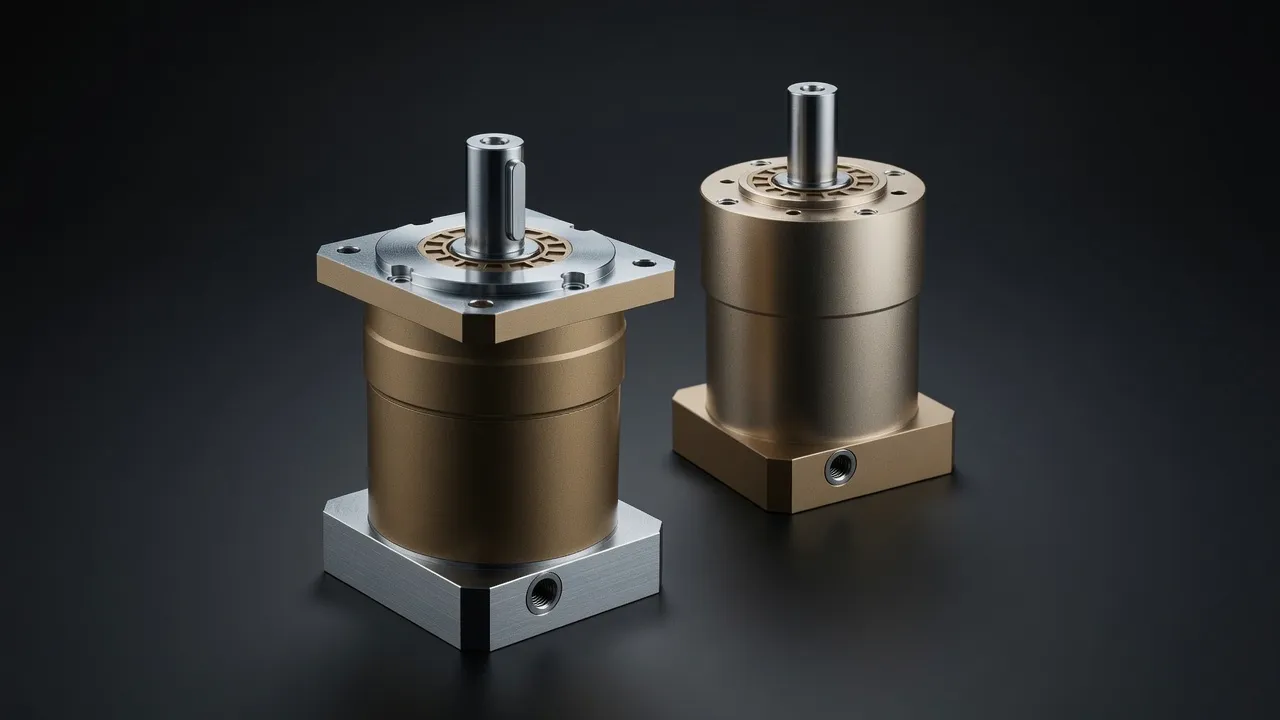
The planet gears must load-share perfectly because unequal loading in an ECVT causes a torque ripple on the ring gear output that is perceptible as a vibration through the drive shaft. The EPG two-stage precision planetary series demonstrates the manufacturing precision achievable in an industrial planetary gear set — helical gears, precision ground, DIN 5 tooth accuracy — which is the same quality level required for ECVT applications. The AB115 high-precision planetary series provides an alternative configuration for ECVT integration tests and vehicle powertrain development rigs.
Lubrication and Thermal Management
The ECVT planetary gear set operates in the same oil bath as MG1 and MG2, creating a combined thermal and chemical challenge: the oil must simultaneously lubricate the gears and bearings (requiring EP additives and adequate viscosity), cool the motor windings (requiring low viscosity for good heat transfer and chemical compatibility with copper and winding insulation), and survive the presence of metallic wear particles that would contaminate a conventional gear oil. Purpose-formulated EV/HEV gear and motor oils address all three requirements in a single fluid.
Frequently Asked Questions
Speak with a Planetary Drive Specialist
Share your torque requirement, ratio, and application environment — our team at Condell Park NSW returns a sized recommendation and stock check within one business day. No obligation.