
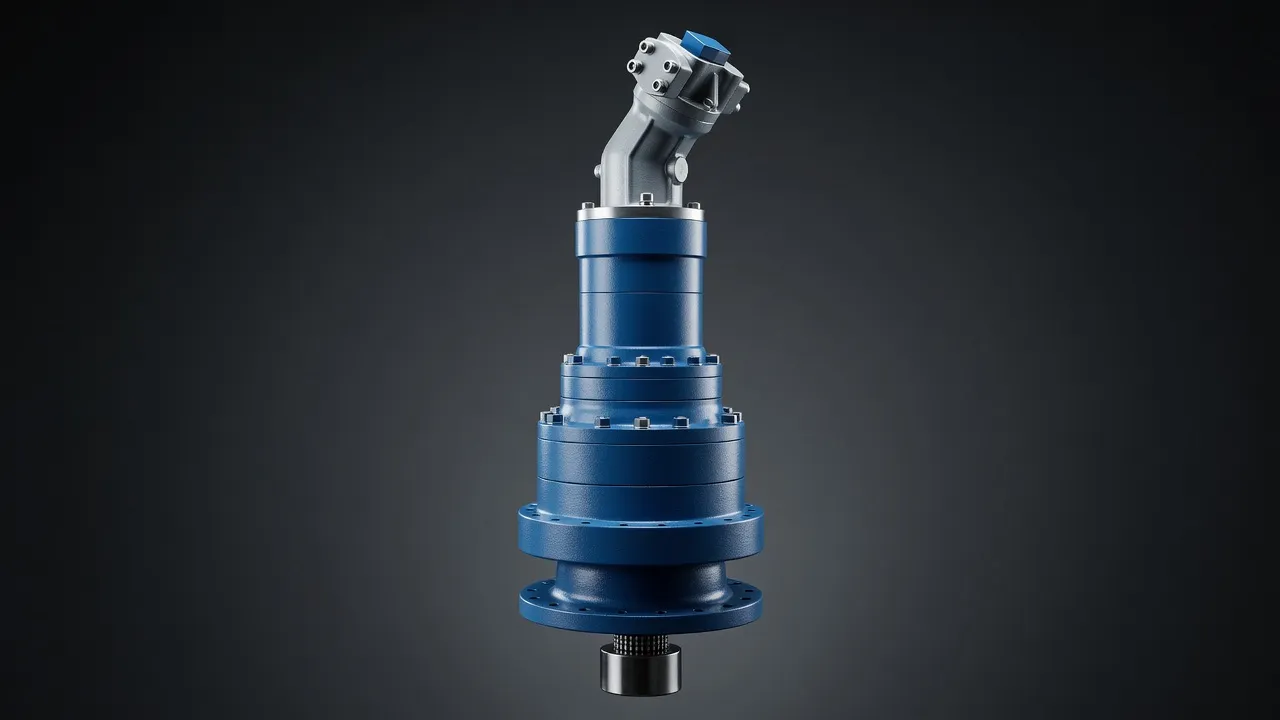
The slewing planetary gearbox on a tower crane rotates the entire jib, trolley, and counterweight assembly around the mast — a structure weighing 15–50 tonnes on a large tower crane, swinging through 360° of arc to position loads anywhere within the crane’s radius. The gearbox must produce enough torque to accelerate this mass to operating swing speed against wind loading, decelerate it smoothly to a precise stop over a load hook, and hold it stationary against wind while the load is attached or released. The planetary gearbox achieves all three requirements in a compact unit that mounts at the top of the mast without adding excessive deadweight to the structure.
Slewing Torque Calculation and Drive Configuration
Tower crane slewing drives typically use two to four independent planetary gearboxes mounted symmetrically around the slew ring gear — the same redundant approach used in wind turbine yaw drives, for the same reason. Each gearbox output pinion meshes with the slew ring gear (typically 1.5–3.5 m diameter), and the combined torque from all drives accelerates the jib assembly. The required total slewing torque for a 40-tonne jib assembly with a 2 m radius of gyration and a target angular acceleration of 0.05 rad/s²: torque = 40 000 × 2² × 0.05 = 8 000 N·m. Adding wind load (typically 30–50% of inertia torque): total ≈ 12 000 N·m, shared across 3 drives = 4 000 N·m per gearbox output.
| Crane Capacity | Jib Mass | Slew Ring Diameter | Number of Drives | Per-Drive Output Torque | Gearbox Ratio |
|---|---|---|---|---|---|
| Light (1–3 t payload) | 5 t | 1.5 m | 2 | 1 500–3 000 N·m | 1:80–1:120 |
| Medium (3–8 t) | 15 t | 2.2 m | 2–3 | 3 000–5 000 N·m | 1:100–1:150 |
| Heavy (8–16 t) | 30 t | 2.8 m | 3–4 | 4 000–8 000 N·m | 1:120–1:180 |
| Luffing jib (5–25 t) | 40 t | 3.2 m | 4 | 5 000–10 000 N·m | 1:150–1:200 |
| Self-erecting (up to 8 t) | 8 t | 1.8 m | 2 | 2 000–4 000 N·m | 1:80–1:120 |
Per-drive output torque = total slewing torque ÷ number of drives.
Holding Torque and Wind Load Management
A tower crane in free-slewing mode (motor de-energised, brake released) allows the jib to weathervane in the wind — the jib swings freely to align with the wind direction, minimising wind load on the structure. In this mode, the slewing brake is released and the planetary gearboxes must allow free rotation (they are not self-locking). When the crane is in working mode, the slewing brake holds the jib stationary for load attachment. During slewing motion, the motor controls the deceleration to a smooth stop — ramp deceleration rates of 0.02–0.05 rad/s² are specified to prevent pendulum swing of the load.
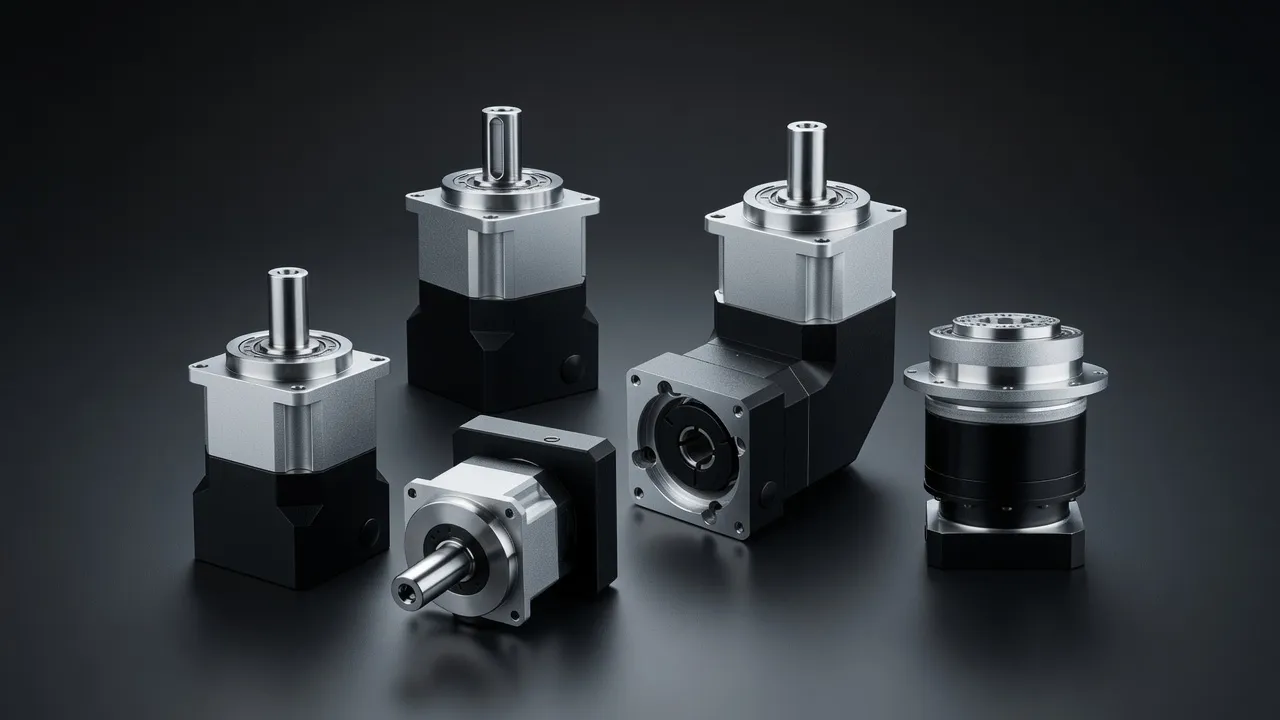
The EPG two-stage precision planetary in compact slewing drive configurations provides the ratio range and torque density required for light to medium tower crane slewing applications. For heavy luffing jib cranes and the largest hammerhead tower cranes, the EPB high-precision torque planetary series with its higher torque capacity and robust housing covers the upper end of the slewing torque requirement.
Marine and Harsh Weather Exposure
Tower cranes operate outdoors across Australia’s full range of weather conditions — from the tropical cyclone zones of North Queensland and Darwin (sustained wind speeds of 50+ m/s during events) to alpine construction sites in the Snowy Mountains (sub-zero temperatures and ice formation). The slewing gearbox housing must be sealed against driving rain and wind-blown construction dust, and the lubricant must flow at −10°C on a cold morning startup while remaining stable at 60°C housing temperature during a full slewing day in summer. Synthetic PAO oil at ISO VG 220 meets both requirements; standard mineral oil at VG 320 is marginal in cold conditions and requires pre-warming in alpine locations.
Slewing Speed Smoothness and Load Pendulum Control
The pendulum effect of a suspended load during slewing creates an oscillation that must be damped before the load can be precisely placed. Anti-sway control systems on modern tower cranes calculate the pendulum frequency from the hook height and apply active deceleration profiles that stop the load swing simultaneously with the jib stop — a technique called command shaping or input shaping. The planetary slewing gearbox must respond precisely to the commanded deceleration profile without backlash-induced lag or compliance-induced overshoot. Low-backlash planetary gearing (below 5 arc-minutes at the gearbox output) is a prerequisite for effective anti-sway performance. For comparable precision positioning applications with wind load considerations, the VRV040 servo-grade precision worm gearbox provides an alternative reference architecture for antenna and positioning applications.
Frequently Asked Questions
Speak with a Planetary Drive Specialist
Share your torque requirement, ratio, and application environment — our team at Condell Park NSW returns a sized recommendation and stock check within one business day. No obligation.