
The anchor windlass on a commercial vessel ¡ª whether a bulk carrier loading iron ore at Port Hedland, a container ship berth-hopping between Brisbane, Sydney, and Melbourne, or a cruise vessel anchoring in the Whitsundays ¡ª is the last line of ground-tackle security when a ship must hold position in exposed anchorages during weather deterioration or port delays. The windlass planetary gearbox must raise an anchor cable weighing 5 to 30 tonnes and a stockless anchor of 3 to 15 tonnes from depths of 30 to 80 m in 3 to 10 minutes, then hold the cable at any point in the hawse pipe under the full holding load without continuous motor power. This combination of very high torque at low speed, rapid deployment, and inherent position-holding defines the planetary windlass gearbox specification.
Windlass Drive Architecture
Marine anchor windlasses use a vertical or horizontal motor driving a two or three-stage planetary gearbox, whose output connects to the windlass wildcat ¡ª the chain sprocket ¡ª through a jaw clutch. The jaw clutch allows the wildcat to be engaged for power hoisting or disengaged for free-fall deployment controlled by the chain brake, independently of the motor. The gearbox ratio is selected to give the rated hauling speed, typically 9 to 15 m/min of chain travel, at the motor rated speed, with the peak bollard pull within the gearbox continuous rated torque.
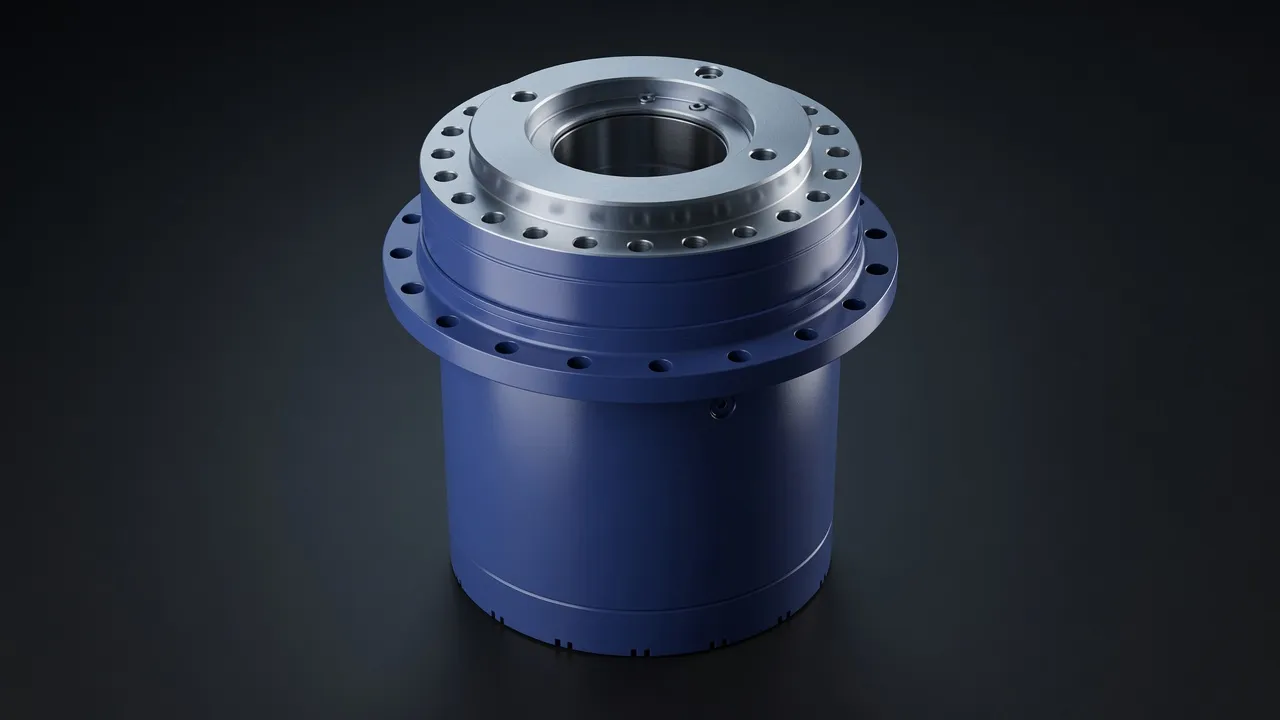
| Vessel Type | Anchor Mass | Cable Weight full scope | Hauling Load air | Wildcat Speed | Gearbox Output Torque |
|---|---|---|---|---|---|
| Coastal ferry 2 000 t DWT | 2 500 kg | 8 t | 80 kN | 12 m/min | 120 000 N¡¤m |
| Handy bulk carrier 30 000 t | 7 500 kg | 25 t | 220 kN | 9 m/min | 350 000 N¡¤m |
| Panamax bulk 60 000 t | 12 000 kg | 40 t | 350 kN | 9 m/min | 560 000 N¡¤m |
| Capesize bulk 180 000 t | 20 000 kg | 70 t | 600 kN | 9 m/min | 960 000 N¡¤m |
| VLCC tanker 300 000 t DWT | 30 000 kg | 100 t | 900 kN | 6 m/min | 1 440 000 N¡¤m |
Hauling load in air = anchor mass + cable mass ¡Á g. In water reduce by buoyancy of approximately 15% for steel chain.
IACS and Classification Requirements
Marine windlass gearboxes must comply with the International Association of Classification Societies machinery requirements and the classification society rules of the vessel flag state ¡ª including Lloyd’s Register, DNV GL, Bureau Veritas, or ABS for Australian-flagged commercial vessels. Classification requirements specify the minimum proof load test at typically 1.5 times the rated hauling load applied statically for 30 minutes, the brake holding test where the chain brake must hold 1.33 times the rated hauling load without chain movement, and the design service factor for the gearbox gear teeth. A gear tooth bending safety factor of at least 2.0 against the proof load is the standard requirement for classification society approval.
Corrosion Protection on Open Forecastle Decks
Ship windlasses are mounted on the exposed forecastle deck ¡ª the most weather-exposed position on any vessel ¡ª subject to green water, salt spray, UV exposure, and the occasional impact from chain cable during anchoring operations in rough weather. The planetary gearbox housing must be sealed to IP66 minimum, externally coated with marine-grade epoxy coating of minimum 250 micrometres DFT, and fitted with a sealed breather to prevent the pressure cycling of the housing from pumping seawater through imperfect seals. All external fasteners must be A4 stainless steel or hot-dip galvanised and caulked with marine sealant to prevent crevice corrosion. The EPX heavy planetary series with marine-grade external coating and IP66 sealing provides the corrosion protection and structural integrity expected of classification-approved windlass gearboxes. The EPB high-precision torque planetary is an alternative for yacht and small vessel windlass applications where classification is not required but marine-grade durability is essential. For comparable corrosion-resistant drives in marine environments, the HSRV stainless steel worm gearbox demonstrates the material and sealing standards applicable to marine-grade industrial drives.
Emergency Anchor Release and Free-Fall Deployment
Emergency anchor release requires deploying the anchor under gravity in the shortest possible time ¡ª the chain brake is released, the wildcat jaw clutch is disengaged, and the anchor and chain fall under gravity until the anchor reaches the seabed and the appropriate scope is set. The gearbox is completely disengaged during this operation and is not involved in the free-fall deployment. The chain brake, not the gearbox, provides the sole holding force during gravity deployment.
Frequently Asked Questions
Speak with a Planetary Drive Specialist
Share your torque requirement, ratio, and application environment ¡ª our team at Condell Park NSW returns a sized recommendation and stock check within one business day. No obligation.