
The pitch drive on a wind turbine blade is one of the most safety-critical planetary gearbox applications in existence. It must rotate each blade precisely around its longitudinal axis — from 0° (full power) to 90° (full feather, no power) — in response to control system commands that fire dozens of times per hour in variable wind conditions, while simultaneously being capable of feathering all three blades to a safe position within 3–5 seconds in an emergency stop. The gearbox that fails to respond to an emergency stop command on a turbine in a 25 m/s gale has destroyed the turbine.
The Pitch Drive Function and Performance Requirements
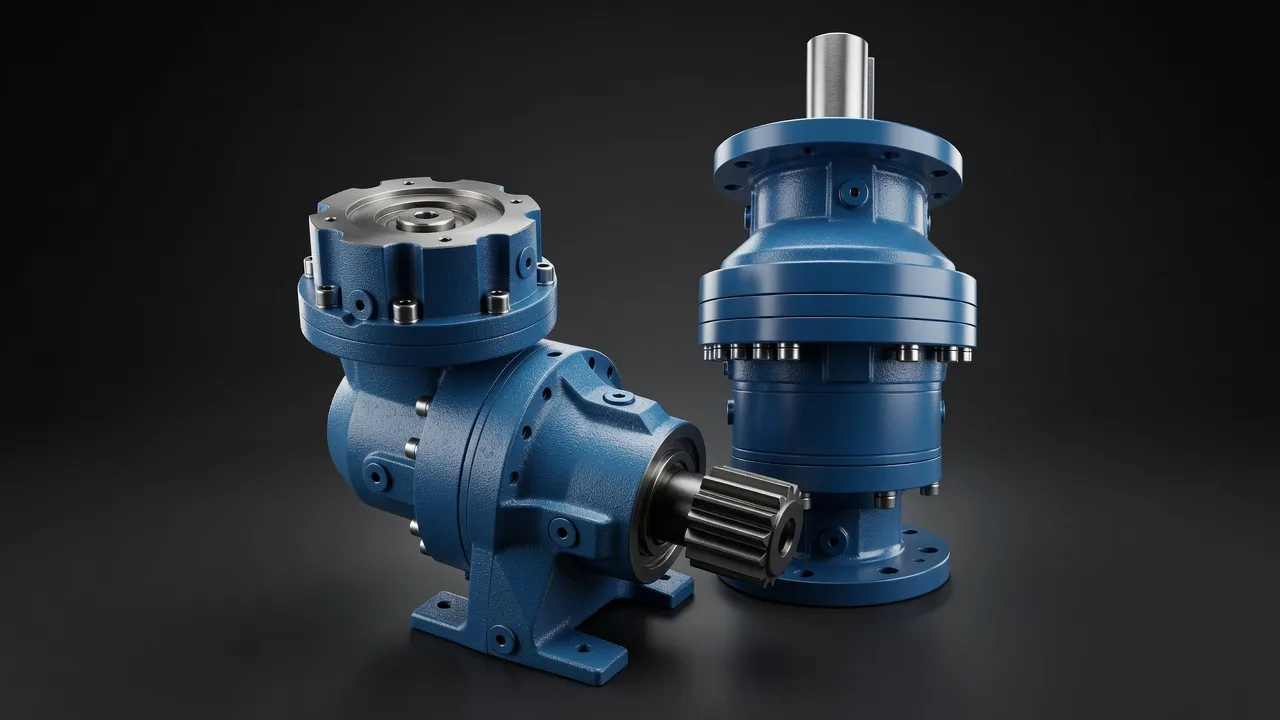
Each blade on a three-bladed turbine has its own independent pitch drive system consisting of an electric motor (or hydraulic actuator on older designs), a planetary gearbox, and a pinion that meshes with the blade bearing ring gear. The planetary gearbox provides the ratio needed to produce the blade angular velocity specified by the control system — typically 3–10°/second for normal operation, up to 15°/second during emergency feathering — from the motor speed (typically 1 500–3 000 rpm for servo motors).
Ratio Calculation for Pitch Drive Applications
The blade ring gear diameter on a 2 MW turbine is typically 1.2–2.0 m. With a pitch drive pinion of 200 mm pitch diameter, the ring-to-pinion gear ratio is 6:1 to 10:1. To achieve 10°/second blade rotation, the pinion must rotate at 10 × (ring diameter ÷ pinion diameter) ÷ 360 × 60 rpm. For a 10:1 ring-to-pinion ratio: pinion speed = 10 × 10 ÷ 360 × 60 = 16.7 rpm. From a 1 500 rpm servo motor, the required planetary gearbox ratio is 1 500 ÷ 16.7 = 90:1. Single-stage planetary ratios go to approximately 1:10; two-stage planetary reaches 1:100 in a compact housing — covering the pitch drive requirement exactly.
Backlash Requirements and Positional Accuracy
Pitch control accuracy directly affects power output: a blade at 0.5° from its optimal pitch angle loses approximately 1–2% of power output at rated wind speed. Over a 20-year turbine life this translates to a meaningful energy yield difference. The IEC 61400-1 standard requires pitch control to within ±0.5° of the commanded angle, which means the entire pitch drive train — gearbox, pinion, and ring gear — must have combined backlash below 0.5° at the blade. A well-specified precision planetary gearbox contributes less than 0.2° of this budget.
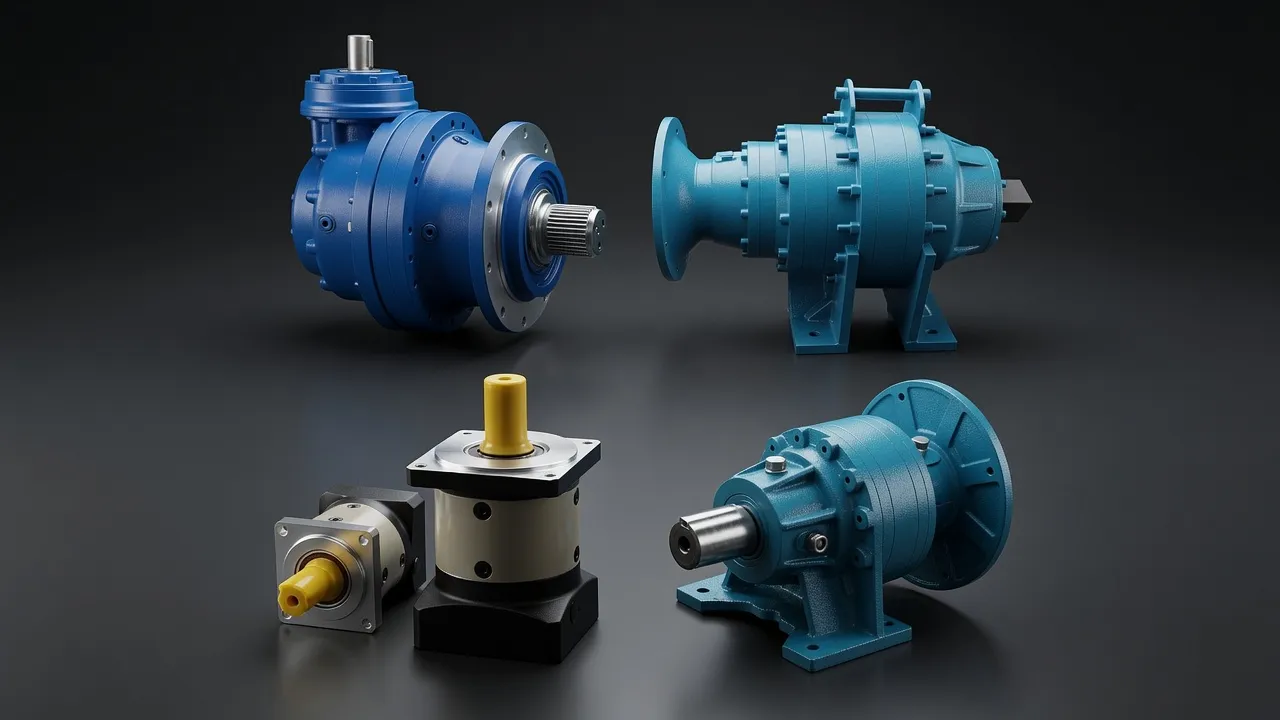
The EPG two-stage precision planetary series with preloaded sun gear achieves output shaft backlash below 3 arc-minutes (0.05°) in a standard configuration — more than adequate for pitch drive accuracy requirements. The AB090 high-precision planetary series provides equivalent precision in a through-hollow shaft configuration that simplifies integration with pitch drive pinion assemblies where the motor cable must pass through the gearbox centre.
| Parameter | Standard Servo Application | Wind Pitch Drive Requirement |
|---|---|---|
| Backlash (output shaft) | <5 arc-min | <3 arc-min |
| Torsional stiffness | 100–300 Nm/arc-min | 500+ Nm/arc-min |
| Emergency stop response | N/A | Full travel (90°) in <5 s |
| Operating temperature | -10°C to +60°C | -40°C to +80°C (nacelle) |
| Service life | 10 000 h | 20 years / 175 000 h |
| Corrosion protection | IP54 standard | IP65 minimum, typically IP67 |
Pitch drive requirements significantly exceed standard servo gearbox specifications.
Emergency Feathering and Backup Power
A pitch drive that fails to respond to an emergency stop command during grid fault or extreme wind must still be able to feather the blade using backup power. Modern pitch systems use a dedicated battery or ultracapacitor backup per blade that can power the pitch motor for at least two full 0–90° feathering operations even with main grid power completely absent. The gearbox must therefore function normally at normal motor voltage and at the reduced voltage of a partially discharged backup battery — which means the motor torque is lower during the battery-powered emergency operation, and the gearbox efficiency must be high enough (typically above 93%) that the available battery power can still drive the blade to the feathered position against the aerodynamic load.
Cold Climate Operation and Low-Temperature Lubrication
Wind turbines in Tasmania, alpine NSW, and the ACT highlands operate in ambient temperatures below −10°C during winter. Standard synthetic PAO oil at ISO VG 220 maintains adequate viscosity down to approximately −30°C for pitch drive gearboxes; below this, a VG 100 PAO or a specific cold-climate formulation is required. The motor must also generate sufficient starting torque at the cold oil viscosity to overcome the increased drag in the gearbox and bearing during the first few pitch movements of the day — this cold-start torque should be verified against the motor thermal rating and the backup battery capacity before finalising the system specification. For a comparison of compact precision planetary drives used in precision angle control applications, the VRV040 servo-grade precision worm gearbox provides a useful reference for alternative gear architectures in servo-controlled pitch positioning.
Frequently Asked Questions
Speak with a Planetary Drive Specialist
Share your torque requirement, ratio, and application environment — our team at Condell Park NSW returns a sized recommendation and stock check within one business day. No obligation.