
Conveyor drives sit at the heart of every packaging line, quarry, food plant, and warehouse sortation system across Australia. Choosing the wrong reducer means stalled belts, burnt motors, and missed shipments. This guide walks through the practical decisions an engineer faces when specifying a worm gearbox for conveyor systems — from torque math to mounting style — and shows how the WP series fits roller, belt, screw, and chain conveyors running anywhere from a few metres per minute to high-speed sortation rates.
Why Worm Gearboxes Dominate Conveyor Drives
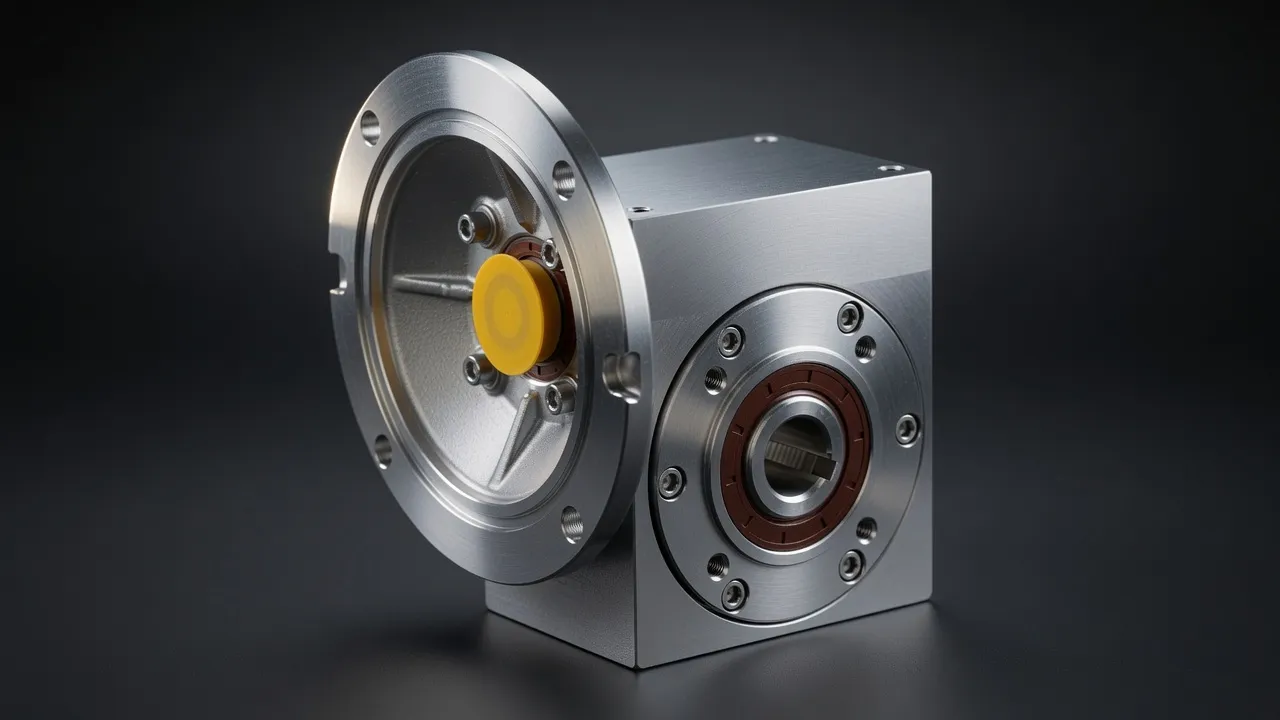
Belt and roller conveyors share two stubborn requirements that fit the worm-and-wheel pair almost perfectly: large speed reduction in a tight footprint, and a right-angle output that drops the motor cleanly beside the frame rather than under the belt. A single-stage worm gear reducer delivers ratios from 1:5 up to 1:60 — replacing what would otherwise need a two-stage helical unit twice the weight. The 90° configuration also keeps the gearbox housing parallel to the conveyor side rail, freeing up floor clearance for cleaning, walkways, and modular conveyor extensions.
A second advantage matters more in practice than spec sheets suggest: the worm pair is largely self-locking at ratios above roughly 1:30. Inclined belts, packaging accumulation lines, and lifting conveyors all benefit because the load cannot drive the motor backwards when power drops. Operators avoid the cost and complexity of separate holding brakes for many low-incline applications. Sliding contact between bronze wheel and steel worm also runs quietly — typically 65–72 dB at the gearbox housing — which makes worm units the default choice for food production, pharmaceutical packaging, and any conveyor running close to workstations.
Sizing the Gearbox to Conveyor Load
Sizing starts with belt pull and head pulley diameter, not motor power. The output torque the gearbox must deliver equals the tangential force at the drive pulley multiplied by the pulley radius, with friction, incline angle, and acceleration factored in. Once that figure is known, the WP series catalogue lists output torque for every centre-distance (size 40 through size 250) at each available ratio. A practical shortcut: take the calculated torque, multiply by a service factor (covered below), and pick the smallest frame whose rated output exceeds that number with at least 15–20% margin to absorb startup transients and belt jams.
Quick reference: torque capacity by frame size at 1:30 ratio
| Frame Size (centre distance) | Output Torque @ 1:30 (N·m) | Typical Conveyor Width | Suggested Motor (kW) |
|---|---|---|---|
| WPA 60 | 62 | 300–500 mm | 0.37 |
| WPA 80 | 151 | 500–650 mm | 0.75–1.1 |
| WPA 100 | 277 | 650–800 mm | 1.5–2.2 |
| WPA 135 | 707 | 800–1000 mm | 3.0–4.0 |
| WPA 175 | 1189 | 1000–1200 mm | 5.5–7.5 |
| WPA 250 | 2745 | 1200 mm+ | 11–15 |
The figures above assume a 1500 r/min input speed driving a steady-load horizontal conveyor. Add roughly 30% to the torque requirement for inclined belts, 50% for screw conveyors handling abrasive bulk material, and double the figure for shock-loaded chain conveyors moving foundry billets or scrap. When the workload sits between two frame sizes, picking the larger one almost always pays back through extended bearing life and lower oil temperatures over the first three to five years of operation.
Selecting Ratio for Target Belt Speed
Belt or roller speed is a downstream calculation once the head pulley diameter is known. The relationship is straightforward: output rpm equals motor rpm divided by the gearbox ratio, and belt speed equals output rpm multiplied by pulley circumference. A 1500 r/min motor feeding a DA series single-stage worm gear reducer at 1:30 produces 50 r/min at the output shaft. With a 200 mm drive pulley, that gives a belt speed of roughly 31 m/min — typical for bottling lines, carton sealers, and small parts assembly conveyors.
For slower lines — slat conveyors in a cheese plant, accumulation tables, or oven exits — ratios of 1:50 or 1:60 bring belt speeds down to 12–18 m/min without dropping motor speed into the variable-frequency drive’s inefficient low-Hz range. When the application calls for very slow movement under heavy load, such as kiln car traction or large slewing-table conveyors, a two-stage WPE unit covers ratios from 1:100 all the way to 1:3600, with the second stage producing output speeds below 1 r/min. Always verify the worm shaft input speed stays within 600–1600 r/min for best efficiency and thermal balance.
Mounting Configurations That Fit Conveyor Frames
The same internal gearing is sold in six housing variants because conveyor framework rarely tolerates a generic mounting. Picking the right configuration up front avoids costly bracketry, oil leaks at the wrong orientation, and shaft alignment headaches during installation. The four configurations below cover roughly 90% of conveyor builds in the field.
Foot-Mounted (WPA / WPS)
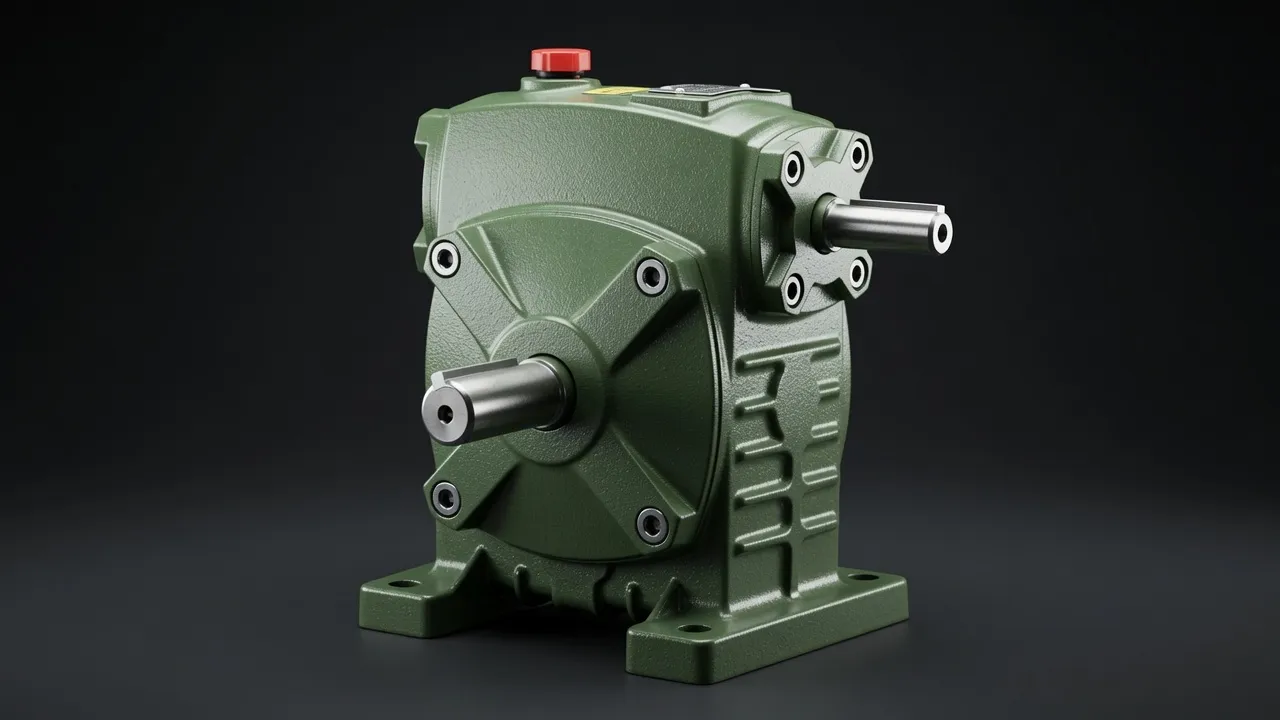
Classic four-bolt baseplate. Use when the conveyor frame has a flat machined surface beside the drive pulley. Solid input and output shafts allow chain, belt, or direct coupling to the head shaft.
Hollow Shaft (WPKA / WPKS)
The KA series hollow shaft worm gearbox slides directly onto the head pulley shaft and is held by a torque arm. Eliminates couplings, chains, and bearing housings — ideal for modular belt conveyors.
Motor Flange (WPDA / WPDS)
IEC B5 or B14 flange on the input side accepts a standard squirrel-cage motor without a separate bell housing. Cuts overall length by 25% and removes coupling alignment work entirely.
Vertical Output (WPO / WPZ)
Output shaft points up. Suits turntable conveyors, rotary indexing tables, and screw conveyors where the auger axis runs vertically through a hopper outlet.
Service Factor and Duty Cycle
A conveyor running 24/7 in a quarry sees very different stress than the same belt running two shifts in a clean packing room. Catalogue torque ratings assume steady operation, ambient temperature around 20°C, and modest reversal frequency. Real applications need a correction factor — usually called the service factor — that multiplies the theoretical torque before sizing. Three variables drive the calculation: hours of daily operation, shock-load character, and how often the conveyor stops, starts, or reverses direction.
Practical service factors for conveyor work
A horizontal belt conveyor in a bakery, running 8 hours per day with smooth product flow, calls for a factor near 1.0. The same conveyor in a recycling plant — handling shock loads of glass and metal, running 16 hours a day with frequent reversal — needs a factor of 1.5 or higher. Inclined conveyors lifting bagged cement at 25° angles often justify 1.75. Ambient temperature also matters: every 10°C above 40°C reduces oil viscosity and load capacity by roughly 10%, which is why conveyor speed reducer selection in foundries or roof-mounted outdoor installations leans toward the next frame size up.
Lubrication and Maintenance for Continuous Operation
Worm gearing runs on sliding rather than rolling contact, which puts unusually high demands on the oil. The film between bronze wheel and steel worm thins quickly under heat or with contaminated lubricant, and once metal-to-metal contact starts the gearbox is on a short countdown. Following the maintenance schedule below extends typical bearing and gear life from a few thousand operating hours to ten years or more in clean conditions.
Maintenance schedule for a belt conveyor gearbox
- First oil change at 100 operating hours — flushes manufacturing debris and bedded-in wear particles.
- Subsequent oil changes every 2500 hours or annually, whichever comes first.
- Use ISO VG 320 mineral oil for ambient temperatures −10°C to +40°C; switch to synthetic PG 460 above 50°C.
- Top up to the centre of the sight glass — overfilling causes foaming and oil seal leaks just as much as underfilling causes scuffing.
- Maximum allowed oil temperature: 95°C. If the housing stays below this and is not climbing, operation is safe even at the upper end.
Bearings rarely fail first in correctly lubricated worm units; the bronze wheel is almost always the wear part. When wear shows up as backlash exceeding 1° at the output shaft, replacement worm-and-wheel kits keep the original housing, mounting, and motor in service. For high-cycle applications such as carwash conveyors or filling-line indexers, comparable solutions like the MRV/NMRV standard worm gearbox series with aluminium housings offer faster heat dissipation, while WP iron-housing units remain the heavy-duty choice for steel-mill, mining, and large bulk-handling conveyors.
Why Source from Ever-Power Transmission Australia
Conveyor downtime in Sydney, Newcastle, Brisbane, or Perth costs the same per hour as it does anywhere else — except spare parts shipped from overseas take 4–6 weeks. Ever-Power Transmission Australia Pty Ltd holds the full WP and WPE range in stock at the Condell Park warehouse, ships to NSW metro within 24 hours, and to other states within 2–3 working days. Local stock means a failed gearbox on a Friday afternoon doesn’t write off the following week’s production schedule, which is the single most important reason food processors, recyclers, and packaging contractors specify Australian-stocked units rather than direct factory imports.
Talk to a conveyor drive specialist
Send the conveyor’s belt width, length, incline, product weight, and target speed. A sized recommendation with torque calculations and a stock check usually arrives within one business day.