
Garage door openers in domestic and commercial settings are among the highest-cycle consumer applications for a worm gearbox — a busy household door operates 8–15 times per day, accumulating over 5 000 cycles per year, while a commercial loading dock door may run 200 or more cycles daily. Despite the familiarity of the application, the torque calculations and safety requirements are often underestimated, particularly for heavy industrial doors, sectional overhead doors on cold store facilities, and tilt-up panel doors on farm sheds where the door weight is substantial and the opening cycle includes a significant moment arm change as the door geometry changes during travel.
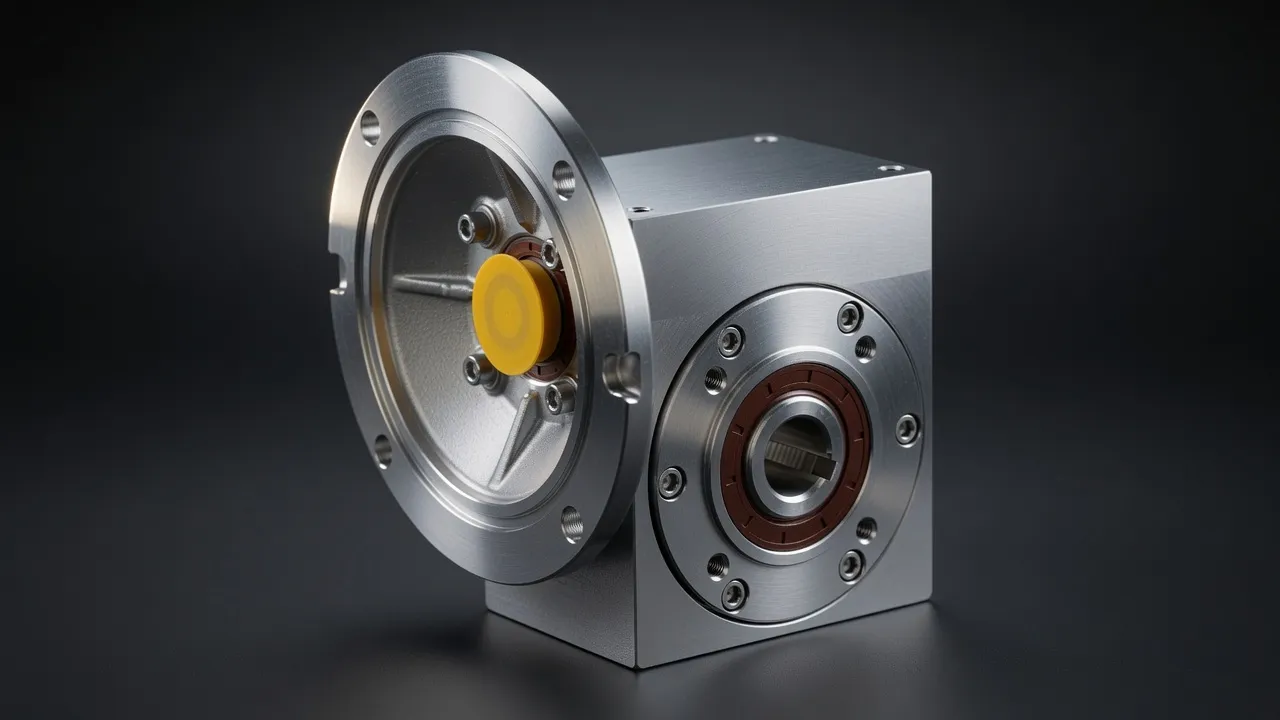
Torque Calculation for Overhead Doors
The peak torque required to open an overhead door occurs at the start of the lifting stroke when the door is fully vertical and the counterbalance spring (if fitted) is at its minimum tension. For a counterbalanced door the net torque is manageable — typically 50–150 N·m for a domestic sectional door — but for an unbalanced door or one with a failed counterbalance spring the torque can be five to ten times higher. Always calculate on the assumption that the counterbalance system could be absent or at end of service life.
The calculation starts with door weight: a 3 m wide by 2.4 m tall steel sectional door weighs approximately 90–130 kg. At the start of the lift stroke, all of this weight acts at the drum radius (typically 75–100 mm). Drum torque = 110 × 9.81 × 0.09 = 97 N·m per drum. With two drums on a common shaft, total shaft torque is 194 N·m. The gearbox output must deliver this torque multiplied by a service factor of 1.5 for commercial duty (300+ cycles/day) = 291 N·m minimum selection torque. A WPA 80 at 1:30 (rated 151 N·m) is inadequate; a WPA 100 at 1:30 (rated 277 N·m) is marginal; a WPA 120 at 1:30 (rated 413 N·m) provides the required headroom.
| Door Type | Door Weight | Drum Torque (per drum) | Service Factor | WP Unit Minimum |
|---|---|---|---|---|
| Domestic sectional, 2.4 m tall | 80 kg | 70 N·m | 1.0 | WPA 80, 1:30 |
| Commercial sectional, 3 m tall | 130 kg | 114 N·m | 1.5 | WPA 120, 1:30 |
| Cold store insulated, 3.5 m tall | 250 kg | 220 N·m | 1.5 | WPA 135, 1:30 |
| Industrial tilt-up, 4 m × 5 m | 600 kg | 530 N·m | 2.0 | WPA 175, 1:40 |
| Fire-rated roller shutter, 4 m wide | 180 kg | 158 N·m | 1.75 | WPA 135, 1:30 |
Drum radius 90 mm assumed. Verify against actual drum dimensions.
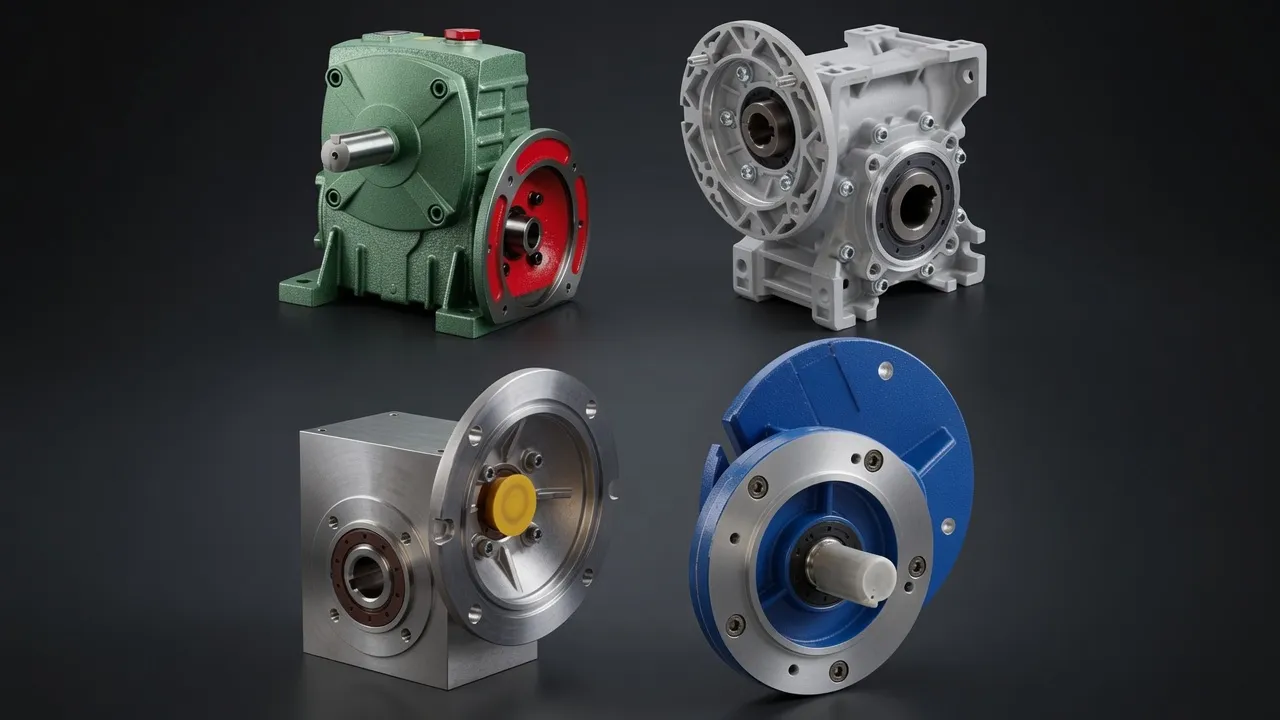
Self-Locking for Door Safety
The self-locking property of a worm gearbox at 1:30 and above is critically important for garage door safety. An overhead door that can be manually pushed open from outside — because the gearbox allows back-drive — is a security vulnerability. A door that drops when the drive motor is de-energised is a safety hazard. At ratios of 1:30 and above, a correctly specified WP worm unit prevents both failure modes without requiring a separate positive lock. The door stays exactly where the motor leaves it, and no amount of external force applied to the door surface can drive the motor in reverse through the gearbox.
Door Speed and Ratio Selection
Standard garage doors travel at 200–300 mm/s during normal operation. For a drum-type drive with a 100 mm radius drum, the drum angular velocity at 250 mm/s belt speed is 250 ÷ 100 = 2.5 rad/s = 23.9 rpm. With a 1440 rpm motor and 1:30 gearbox, the drive shaft turns at 48 rpm — faster than required. Either a 1:50 ratio or a VFD reducing the motor to around 700 rpm achieves the target. Higher ratios also increase self-locking margin, which is beneficial for security. The DA series motor-flange worm reducer in a compact head unit is the standard choice for commercial sectional door systems.
Safety Devices and Standards Compliance
Australian Standards AS 5010 (automatic gates and doors for pedestrian and vehicle access) requires that power-operated garage doors have reversing sensors, manual release, and emergency stop provisions. The worm gearbox interacts with these requirements through the reversing mechanism — most controllers monitor motor current and reverse the door when the current spikes, indicating an obstruction. A correctly sized gearbox (one that does not normally run near current limit) gives more reliable obstruction sensing because the current spike from contact is proportionally larger against the normal baseline. An undersized or worn gearbox running at elevated current conceals obstruction signals and increases the risk of a door closing on a person or vehicle.
Noise and Vibration in Residential Installations
A garage door opener runs in a living environment, often with bedrooms above or beside the garage. Worm gearing at typical door opening speeds (20–50 rpm output) generates noise in the 200–500 Hz range — lower in frequency and generally less irritating than the higher-pitched whine of helical gearing at equivalent loads. The main noise sources in a door opener are the gear mesh, the chain or belt from the gearbox to the trolley, and the door rollers in the track. The gearbox contribution is typically the smallest of these. Mounting the drive unit on rubber isolators between the unit bracket and the ceiling framing reduces structure-borne vibration transmission to the floor above by 10–15 dB, which is the single most effective noise reduction measure in a residential installation.
Maintenance Schedule for High-Cycle Commercial Doors
Commercial loading dock doors cycling 200 times per day accumulate 2 500 operating hours in approximately 180 days at a 14-hour operating day. This means the first scheduled oil change is due within six months of commissioning — far sooner than most building maintenance programs expect. The KA hollow shaft series simplifies oil changes in installed door openers because the housing is accessible without removing the drive shaft connection. For standard industrial overhead door applications, the BGV055 compact worm reducer is an alternative worth reviewing for very tight head room installations where a standard WP housing does not fit within the door clearance envelope.
Frequently Asked Questions
Speak with a Drive Specialist
Send through your load data, speed requirement, and application environment — our team at Condell Park NSW provides a sized gearbox recommendation and stock availability check within one business day. No obligation.